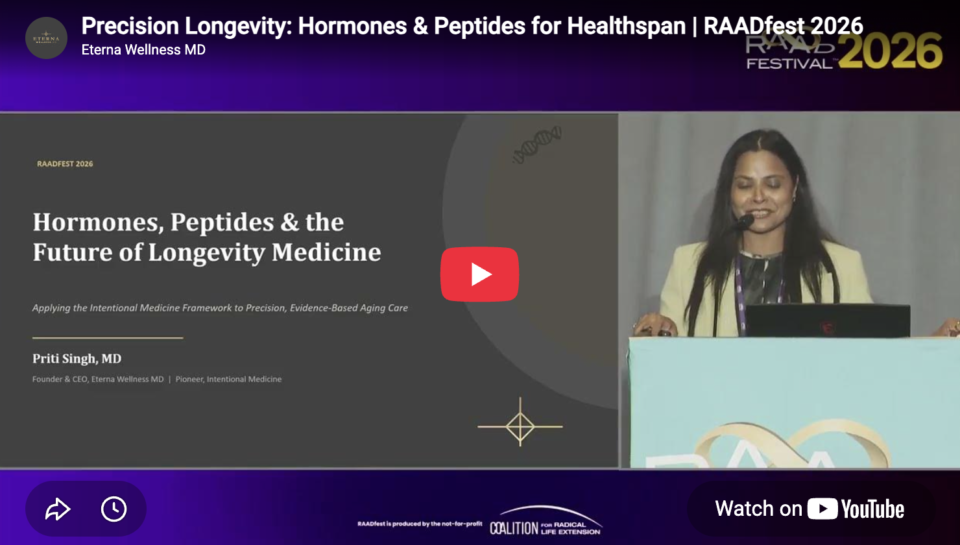
What if the first sign of aging was not a diagnosis, but a measurable change we could identify years earlier? That question shaped my presentation at RAADfest 2026, where I had the opportunity to speak about something I care deeply about: how we approach longevity medicine.
We are living through an exciting time in medicine.
We have better diagnostics, genetic testing, peptides, hormone therapies, regenerative treatments and an increasing amount of data about how we age.
But with all of this information comes another problem.
How do we decide what actually matters?
Because more tests do not always mean better care. And having access to more therapies does not automatically mean we should use them.
I believe longevity medicine needs a framework.
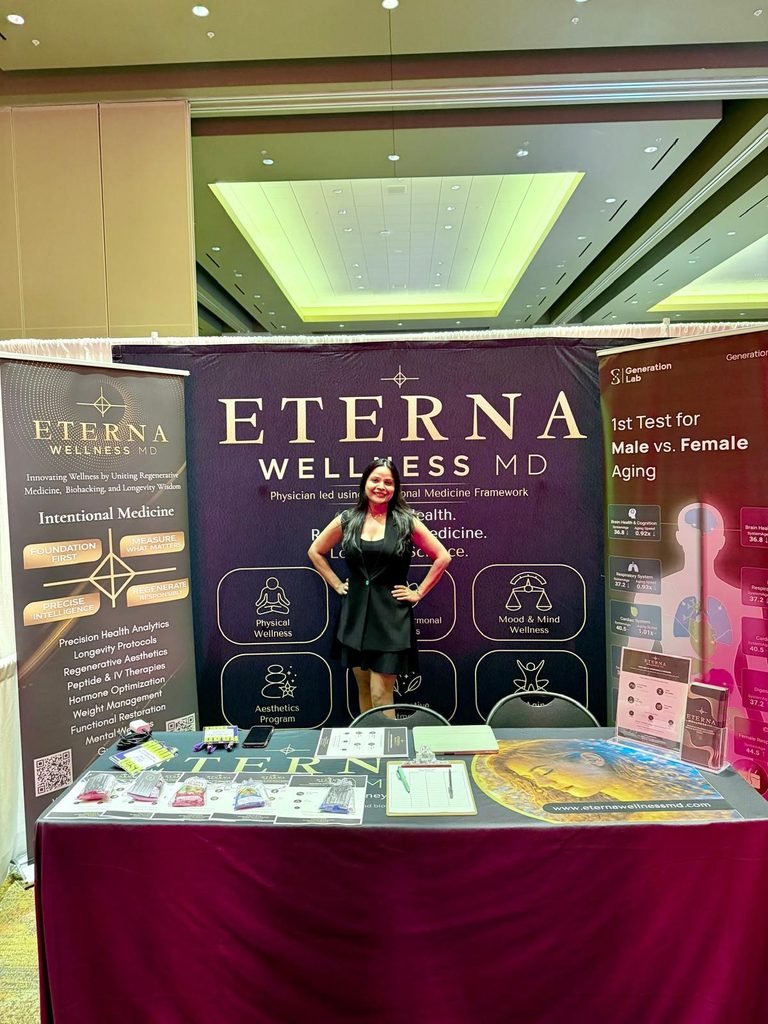
Representing Eterna Wellness MD RAADFest.
From reactive care to intentional care
Traditional healthcare is very good at treating disease when something goes wrong.
If you have a heart attack, you need appropriate emergency medical care. That is not the time to experiment with wellness trends.
But what happens before that crisis?
What if our focus was not only on treating disease, but on understanding changes in health earlier and taking action before those changes become a major problem?
That is where I see the role of intentional medicine.
The goal is to move toward care that is:
- Precise
- Personalized
- Preventive
- Regenerative
But there is an important order to this.
Regenerative therapies should not be the starting point.
The four pillars of intentional medicine
The framework I shared at RAADfest is built around four ideas.
1. Foundation first
Before we talk about hormones, peptides or other regenerative therapies, we need to look at the basics.
Nutrition.
Movement.
Sleep.
Breathwork.
These are not secondary parts of longevity care.
They form the foundation.
We cannot build a meaningful long-term health plan while ignoring the factors that influence our health every single day.
2. Measure what matters
Today, it is possible to measure hundreds of biomarkers.
But should we?
If we order 200 tests, some will probably come back outside the reference range. That can create anxiety without necessarily helping the person sitting in front of us.
The better question is:
What are we measuring, and what will we do with the information?
A test should help us make a decision.
If it cannot change the plan, it may simply be adding noise.
3. Personalize intelligently
There is no single health plan that works exactly the same way for everyone.
We differ in genetics, environment, lifestyle, nutrition and many other factors.
So why should our care be identical?
A treatment that is useful for one person may not be appropriate for another.
That is why personalized care requires more than looking at a lab report. It requires understanding the person behind the numbers.
4. Regenerate responsibly
Hormones, peptides, exosomes and stem cell therapies are powerful tools.
But powerful tools need to be used carefully.
The question should not simply be:
“Can we use this therapy?”
It should be:
“Is this the right therapy for this person, at this time, for this reason?”
That distinction matters.
A therapy may have potential and still not be appropriate for a particular patient.
Safety cannot be something we add at the end of a treatment plan.
Safety has to be part of the plan from the beginning.
Where do hormones and peptides fit?
Hormones and peptides have become major topics in the longevity space.
And for good reason.
They are biological messengers involved in many processes in the body. Hormonal changes also interact with several changes we associate with aging, including body composition, energy, cognition, mood and metabolic health.
But the conversation around them needs more nuance.
We cannot simply ask whether a hormone or peptide is “good” or “bad.”
We need to ask:
- What evidence do we have?
- Who was studied?
- What outcome were they studying?
- What are the risks?
- Is the person in front of us an appropriate candidate?
- What are we trying to achieve?
That is where clinical judgment becomes important.
Evidence matters. But so does the person in front of you.
One of the points I wanted to make at RAADfest is that the science of aging has moved quickly.
But the evidence has not advanced equally for every therapy.
There are areas where we have strong clinical evidence.
There are areas where human data is more limited.
And there are areas where we are still relying on earlier-stage research.
That does not mean we simply stop thinking.
It means we need to understand where a therapy sits on the evidence ladder and make decisions accordingly.
Evidence helps move a therapy toward clinical practice.
But evidence alone does not tell us everything about an individual.
That requires personalization.
What does this look like in practice?
At Eterna Wellness, the process starts with understanding the individual.
We look at foundational health, goals, medical history and potential contraindications.
From there, appropriate diagnostics can help build a clearer picture.
Genetic information may tell us about predispositions.
Laboratory testing gives us a snapshot of where someone is today.
But clinical judgment is what connects those pieces and turns them into a plan.
That is why hormones, peptides, exosomes or other regenerative therapies should not automatically be the first step.
They are tools.
The framework determines when, why and how those tools should be considered.
Watch the full video here to understand the breakdown.
The future of longevity medicine
I believe the future of longevity medicine will be less about finding the next exciting molecule and more about making better decisions earlier.
Using better data.
Asking better questions.
Understanding the evidence.
Personalizing care.
And knowing when not to use a therapy.
AI can help us process information and improve efficiency. But it cannot replace clinical judgment or critical thinking.
The goal is not to chase every new treatment.
The goal is to understand the person, understand the evidence and make the right decision for that individual.
Longevity is not about luck. It is intentional.