Walk into almost any gym in 2026, from hardcore iron basements to luxury fitness clubs, and you will hear the same words floating through locker rooms: BPC-157, CJC-1295, Ipamorelin.
Peptides have become the new frontier of fitness optimization. They live in a gray zone between supplements and pharmaceuticals. Marketing promises fast recovery, rapid muscle growth, and fat loss with minimal effort.
The reality is more nuanced. Peptides are neither magic nor meaningless. Understanding how they work, what they actually do, and where the real risks lie is essential before considering them.
The Science Behind Peptides
What Are Peptides?
Peptides are short chains of amino acids. Amino acids are the building blocks of proteins. If a protein is a long structure, a peptide is a small functional segment.
Peptides act as signaling molecules. They do not build muscle or heal tissue directly. Instead, they tell the body what to do by sending signals to glands, cells, or repair systems.
In simple terms, peptides send instructions. Your body does the work.

Types of Peptides Used in Bodybuilding
In fitness and bodybuilding, peptides generally fall into three categories:
Growth Hormone Secretagogues
These peptides signal the pituitary gland to release more growth hormone.
Common examples include:
- CJC-1295
- Ipamorelin
Tissue Repair Peptides
These peptides signal tissue repair and regeneration pathways.
Common examples include:
- BPC-157
Structural Peptides
These provide raw materials for connective tissue support.
Common examples include:
- Collagen peptides
Do Peptides Actually Build Muscle?
The Growth Hormone Reality
Peptides like CJC-1295 and Ipamorelin do increase growth hormone and IGF-1 levels. Studies show increases of 200 to 300 percent.
However, higher hormone levels do not automatically translate into dramatic muscle growth in healthy adults.
Growth hormone supports recovery, sleep quality, fat metabolism, and tissue repair. It is not a powerful anabolic driver like testosterone or anabolic steroids.
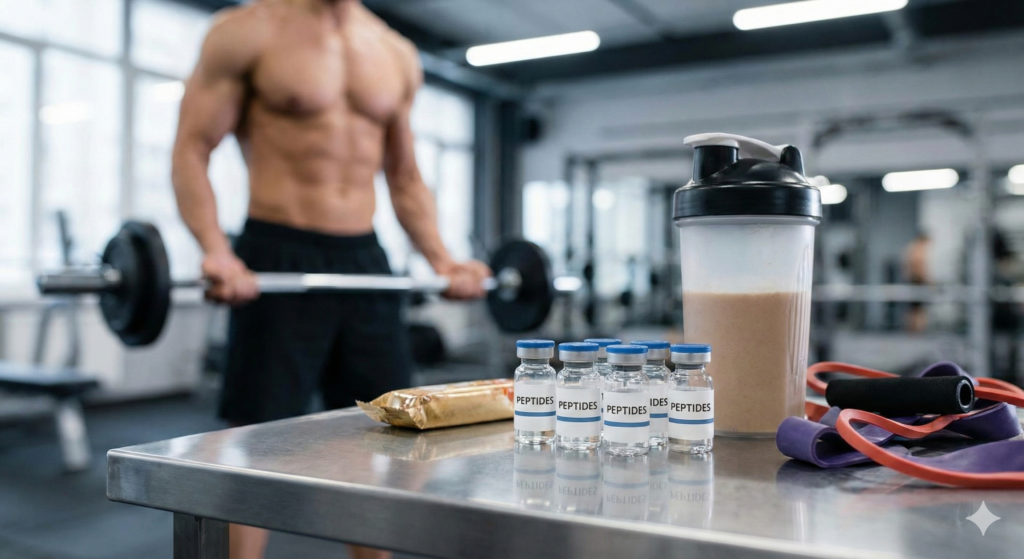
For most people, these peptides help you recover better so you can train harder. They do not independently add large amounts of muscle.
They are support tools, not primary muscle builders.
The Unexpected Winner: Collagen Peptides
The most effective peptide for muscle support is also the simplest and most accessible.
Collagen peptides have strong clinical evidence behind them. Research shows that consuming around 15 grams of collagen daily, combined with resistance training, leads to measurable improvements in muscle mass and strength.
Collagen strengthens the extracellular matrix, the connective scaffolding that supports muscle fibers. It improves force transmission, joint stability, and recovery.
It is not flashy, but it works.
The Injury Repair Question
Peptides like BPC-157 are widely discussed for tendon and ligament healing. Animal studies show impressive tissue regeneration effects. Human data is limited.
Some athletes report reduced pain and faster recovery from stubborn injuries. These outcomes are not guaranteed and should not be treated as proven cures.
Peptides may support healing. They do not replace proper diagnosis, rest, or rehabilitation.
The Safety Problem
The Research Chemical Trap
The biggest risk with peptides is not always the peptide itself. It is the source.
Many peptides are not FDA-approved for bodybuilding use. This has created a black market of products labeled “for research purposes only” or “not for human consumption.”
This labeling protects sellers, not buyers.
Independent testing has shown that a significant percentage of online peptides contain incorrect dosages, impurities, or contaminants. Sterility is not guaranteed.
Injecting unregulated compounds carries real risk.
Biological Risks of Peptides
Chronically elevating growth hormone levels can cause problems, including:
- Insulin resistance
- Increased risk of type 2 diabetes
- Water retention
- Carpal tunnel syndrome
There is also a theoretical cancer risk. Growth factors stimulate cell growth. If pre-cancerous cells are present, increased growth signaling may accelerate their progression.
These risks are rarely discussed by influencers or online sellers.
The Cost Reality
A comprehensive peptide protocol can cost between $500 and $2,000 per month.
If sleep is poor, diet is inconsistent, or training is unfocused, peptides offer minimal return. They cannot compensate for a broken foundation.
Peptides represent marginal gains. They are the final layer of optimization, not the base.
A Safer Approach in Peoria
Peptides are not inherently useless or dangerous. Unsupervised peptide use is.
There is a major difference between purchasing unregulated products online and working with a medical provider who understands your health history, blood work, and risk profile.
At Eterna Wellness MD, located at 21753 N 77th Ave in Peoria, peptide use is approached cautiously and clinically. Patients are evaluated for actual deficiencies, contraindications, and safer alternatives.
In many cases, evidence-based options like collagen supplementation, sleep optimization, hormone balance, and structured training provide greater benefit with far less risk.
Peptides are powerful tools. Powerful tools require medical oversight.
Peptides for Bodybuilding FAQs
Do peptides build muscle like steroids?
No. Peptides do not have the anabolic power of testosterone or anabolic steroids. They primarily support recovery, sleep, and tissue repair.
Are growth hormone peptides safe?
They can be safe under medical supervision. Moreover, unsupervised use increases risks such as insulin resistance, water retention, and metabolic issues.
Is BPC-157 proven to heal injuries?
Animal studies are promising. Human data is limited. Results vary and are not guaranteed.
Are peptides legal?
Some peptides are prescribed for medical conditions. Many bodybuilding peptides are sold through legal loopholes and are not FDA-approved for human use.
What is the safest peptide for muscle support?
Collagen peptides have the strongest safety and efficacy profile and are supported by human clinical studies.
Should beginners use peptides?
No. Beginners should focus on sleep, nutrition, resistance training, and hormone health first. Peptides are not foundational tools.
How do I know if peptides are right for me?
A medical evaluation including blood work, health history, and risk assessment is required. This should be done with a qualified provider.
Contact Eterna Wellness MD today to discuss a medically supervised approach to performance.