
For decades, the roadmap for treating depression and severe anxiety has remained largely the same: try a daily pill, wait six weeks, and hope for the best.
For many, this works. But for roughly 30% of patients, traditional antidepressants are a dead end. Moreover, the medication might numb the symptoms, but the heaviness remains.
This is known as Treatment-Resistant Depression (TRD). The problem isn’t necessarily that the patient is “resistant” to healing; it’s that we have been pulling the wrong lever.
While traditional medications act like a daily maintenance crew, Ketamine acts like a team of architects. Here is the biological difference between managing symptoms and regenerating the mind.
The Limits of the Serotonin Model
Most traditional antidepressants (SSRIs) operate on the “Monoamine Hypothesis.” The theory is that depression is caused by a deficiency in neurotransmitters like serotonin, dopamine, or norepinephrine.
The goal of an SSRI is to keep more serotonin floating around in your synaptic gaps. Think of this like topping up the oil in a car engine. If the oil level is low, the car runs poorly. By adding oil, you keep the engine running.
But what if the problem isn’t the oil level? What if the engine’s wiring is physically disconnected? No amount of extra serotonin will fix a broken connection. This is where traditional meds fail, and where Ketamine enters the picture.
The Glutamate Switch
Ketamine ignores the serotonin system entirely. Instead, it targets Glutamate.
Glutamate is the most prominent neurotransmitter in the brain, responsible for over 90% of synaptic activity. It is the chemical messenger that tells neurons to fire and communicate.
In brains suffering from chronic depression or trauma, stress hormones (like cortisol) have often damaged these glutamate receptors. The neurons literally shrink. The “talk” between different areas of the brain slows down.
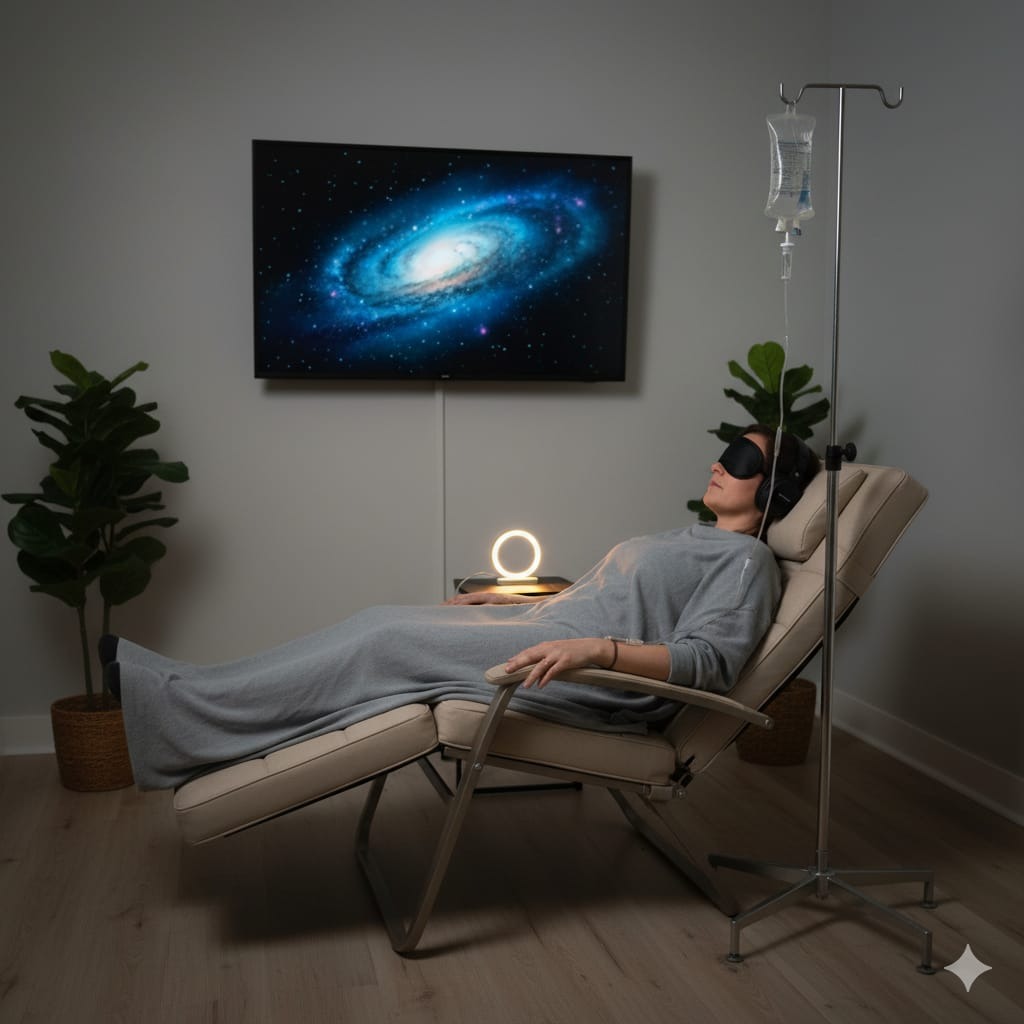
Ketamine binds to these NMDA receptors and triggers a rapid surge of glutamate. It’s not a slow drip; it’s an immediate activation. This is why relief can often be felt in hours, not weeks.
BDNF: Fertilizer for the Brain
The most profound aspect of Ketamine isn’t just the immediate relief—it’s the regeneration.
When Ketamine activates those glutamate receptors, it triggers the release of a protein called BDNF (Brain-Derived Neurotrophic Factor).
You can think of BDNF as “Miracle-Gro” for your brain cells. It encourages neurons to sprout new branches (dendrites) and form new connections (synapses). This is neuroplasticity in its purest form. The brain isn’t just feeling better chemically; it is physically rebuilding the infrastructure needed for resilience. This structural repair allows the brain to bypass old, depressive pathways and create new, healthy ones.
Quieting the Default Mode Network
Psychologically, depression often feels like being stuck in a loop of negative thoughts; rumination that you can’t turn off. This activity lives in a brain circuit called the Default Mode Network (DMN).
In a depressed brain, the DMN is hyperactive. It is constantly analyzing, judging, and regretting.
Ketamine temporarily quiets the DMN. It disrupts this loop. Patients often describe this as a “hard reset” or a moment of profound distance from their problems. It doesn’t erase the trauma, but it removes the emotional weight attached to it, allowing you to look at your life objectively rather than critically.
The Utility of Dissociation
One of the most misunderstood aspects of Ketamine is the psychotropic experience itself. In traditional medicine, side effects are bugs; in Ketamine therapy, the dissociative effect is a feature.
Depression and anxiety often fuse your identity with your suffering. You don’t just feel sad; you are sad. The pain feels like a permanent texture of your reality.

Ketamine induces a temporary separation between the “self” and the “sensation.” For roughly 40 minutes, the observer is decoupled from the narrative. This isn’t just escapism; it is a biological pattern interruption. By momentarily stepping outside your own ego, you gain the ability to view your trauma without the visceral, physiological recoil that usually accompanies it.
This “time out” allows the nervous system to stand down from its chronic fight-or-flight state. It shows the brain that it is possible to exist without the weight of depression, creating a sensory blueprint for what “okay” actually feels like.
Entropy and the Rigid Brain
To understand why this matters, we have to look at the “Entropic Brain” hypothesis. A healthy brain operates in a state of “criticality” a balance between order and chaos.
A depressed or anxious brain is often too rigid (low entropy). It is stuck in deep, repetitive grooves of negative thought patterns that are nearly impossible to climb out of using willpower alone. This is why “just think positive” is useless advice for a clinically depressed person; their neural architecture is locked down.
Ketamine injects a controlled dose of “chaos” (entropy) into this rigid system. It shakes the snow globe. It flattens the energy landscape of the brain, dismantling those deep grooves and allowing neural activity to flow into new, unexplored territories.
This is distinct from numbing the pain. Numbing is static; Ketamine is dynamic. It doesn’t just mute the noise; it fundamentally reorganizes how the brain processes the signal, turning a rigid structure into a flexible one.
The Window of Opportunity
Ketamine is a powerful catalyst, but it works best when paired with guidance.
Because Ketamine induces a state of high neuroplasticity, the days immediately following an infusion are a “critical window.” Your brain is softer, more malleable, and ready to learn new habits. This is why we integrate Ketamine Therapy with Psychotherapy and Integration.
Real recovery isn’t about erasing the past; it’s about metabolizing it. Ketamine provides the biological capability to do that work. It turns the “hardware” of the brain from a rigid, defensive structure into a flexible, adaptive system. But the “software” the new habits, the processed trauma, the emotional regulation is built in the days that follow.
The medicine breaks the lock; you still have to open the door. At Eterna Wellness, we have seasoned medical experts that can help you understand if you can benefit from Ketamine and the right protocol for your condition. Contact us now.