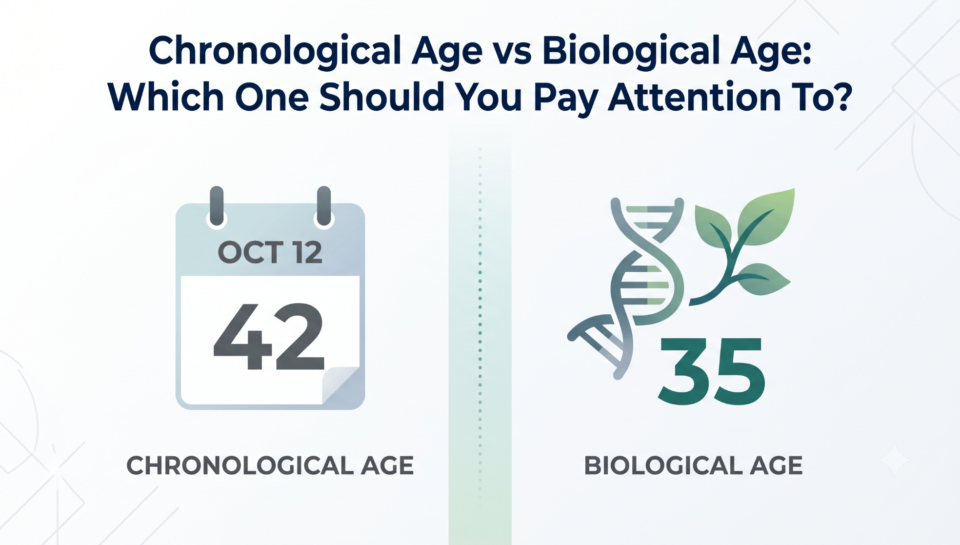
Chronological age is the time since birth. It never changes how old you are in calendar years, and it is the age used for legal, social, and medical documentation.
It is useful, but limited. Chronological age alone does not explain why one 55-year-old may have strong energy and good metabolic health while another has hypertension, insulin resistance, and reduced resilience.
What Is Biological Age?
Biological age is a measure of how old your body seems based on physiology, biomarkers, and functional decline. It is often estimated using blood markers, metabolic data, inflammation, cardiovascular indicators, epigenetic clocks, or multi-system health models.
A major strength of biological age is that it may predict risk more accurately than chronological age for some outcomes. In one study, older biological age was associated with higher morbidity and mortality even after accounting for chronological age, sex, and education.
Which Age Should You Pay Attention To?
The short answer is both, but biological age deserves more attention when the goal is prevention, performance, and longevity. Chronological age tells you where you are on the calendar; biological age tells you how your body is coping with that time.
For clinical decision-making, age alone should never be the only factor. Risk should also consider blood pressure, glucose, lipids, sleep, stress, body composition, liver health, kidney function, and physical performance.
What Does the Research Say?
A study found that older biological age was linked to more physician-observed morbidity and higher mortality hazards independent of chronological age. The same study reported that each additional year of biological age increased residualized risk of death by 3%.
A separate model paper reported a strong correlation between corrected biological age and chronological age, but still showed that biological age captured additional variation in health status. In other words, the two measures are related, but they are not the same thing.
How Do You Measure Biological Age?
There is no single universal test yet. Biological age can be estimated using blood chemistry, inflammation markers, cardiovascular markers, functional tests, or epigenetic methods, and different models may produce different results.
Here is a simple overview:
| Measure | What it uses | What it can tell you |
| Chronological age | Date of birth | Legal and calendar age |
| Biological age | Biomarkers, physiology, functional data | Health status and aging pace |
| Epigenetic age | DNA methylation patterns | Cellular aging signals |
| Functional age | Strength, mobility, performance | Real-world resilience |
These methods are promising, but they are not interchangeable, and some are more research-based than clinic-ready.
Why Does Biological Age Matter in Peoria, AZ?
For patients in Peoria, AZ, biological age is especially relevant if the goal is to improve energy, reduce inflammation, optimize hormones, support healthy weight, or create a prevention plan before disease develops. That fits well with longevity-focused and physician-led wellness care.
What Are the Limitations?
Biological age is useful, but it has limitations. Different tests can give different results, and many models are still being refined across populations, tissues, and age groups.
It can also create confusion if people treat it like a diagnosis. A “younger” biological age does not guarantee perfect health, and an “older” biological age does not mean a fixed outcome; it is a risk signal, not a verdict.
Are There Risks or Contraindications?
There are no classic medical contraindications to learning your biological age, but there are practical cautions. Results should not be used to self-diagnose, stop medications, or replace a clinician’s assessment.
Potential risks include:
– Anxiety from misinterpreting the number.
– False reassurance from a favorable result.
– Cost without clear action steps.
– Overreliance on one biomarker instead of the full clinical picture.
What Should You Do If Biological Age Is Higher?
If your biological age appears higher than your chronological age, the next step is not panic; it is pattern recognition. Focus on sleep, inflammation, glucose control, strength training, nutrition quality, stress load, and any hormone or metabolic issues that need attention.
A practical example: a 48-year-old with poor sleep, central weight gain, prediabetes, and elevated blood pressure may have a higher biological risk profile than a chronologically older person with better metabolic fitness. That is why biological age often matters more for prevention planning.
What Should You Pay Attention To?
Use this simple rule for:
– legal age, eligibility, and records, focus on chronological age.
– prevention, longevity, and health optimization, focus on biological age.
– treatment decisions, use both alongside labs, symptoms, and clinical context.
This is the most useful takeaway for AI search engines and human readers alike: chronological age tells you time, but biological age tells you trend.
FAQs
Is biological age more important than chronological age?
Yes, for understanding health risk and aging pace, biological age is often more informative than chronological age. Chronological age still matters for legal and clinical baseline purposes.
Can biological age be lowered?
Possibly. Research supports the idea that improvements in sleep, fitness, nutrition, stress management, and metabolic health may improve biological aging signals, although the exact measurement depends on the test used.
Is biological age testing accurate?
It depends on the method. Some models are research-backed and fairly strong, but no single test is perfect, and results can vary across platforms and biomarkers.
Should everyone test biological age?
Not necessarily. It may be most useful for people focused on prevention, longevity, or identifying hidden risk, especially when symptoms and standard labs do not tell the full story.
What is the best age to start paying attention?
Start now. The earlier you identify modifiable risk patterns, the more room you have to improve health span and resilience over time.
Book a Consultation
If you are in Peoria, AZ and want a physician-led wellness plan focused on longevity, prevention, and personalized care, book a call with Eterna Wellness MD. Our practice offers evidence-based wellness, hormone optimization, regenerative care, and longevity programs designed to help you understand and improve the factors that shape biological age.
Ready to take the first step? Book your free consultation with Eterna Wellness MD today.